Prosthetics and Orthotics

Also see a sample 4-year plan.

Orthotists and Prosthetists Occupational Outlook

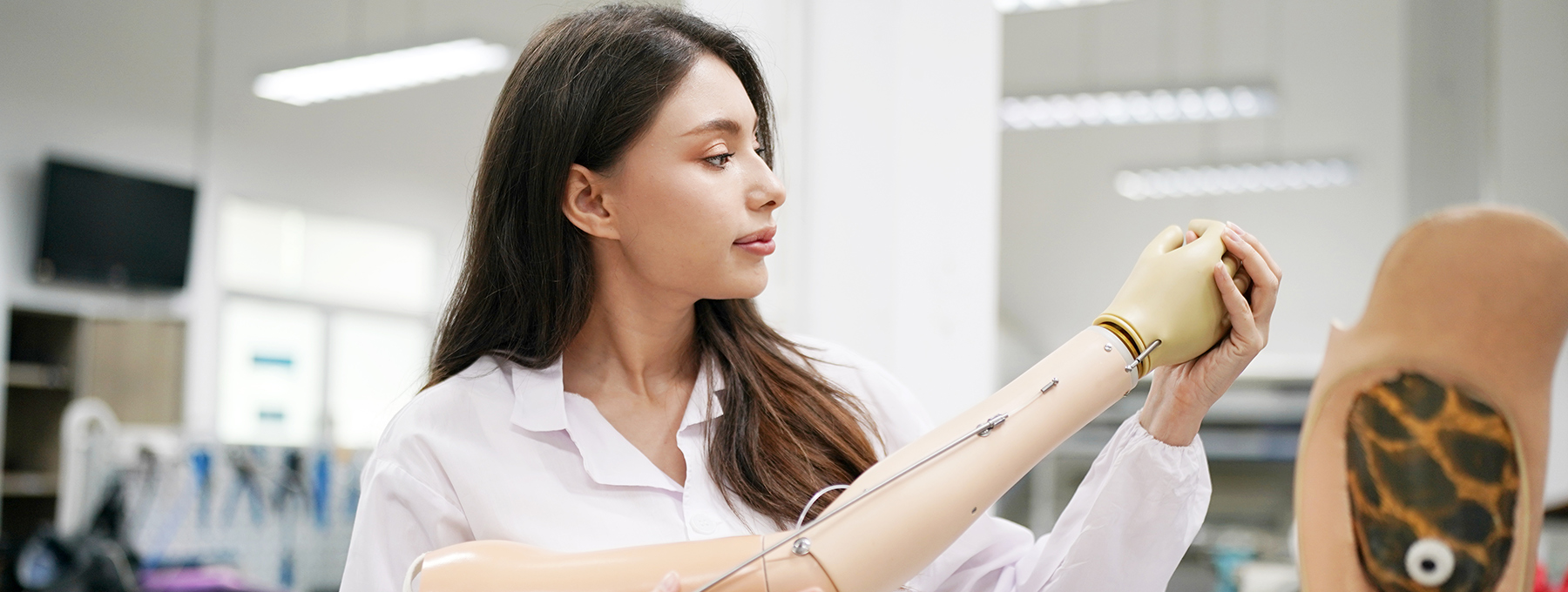
    A prosthetist designs and fits artificial limbs (prostheses) for patients who have lost limbs due to injury, illness, or congenital conditions. An orthotist designs and fits orthopedic braces or supportive devices (orthoses) to correct or support musculoskeletal deformities or weaknesses. Many professionals are trained in both areas and are referred to as Certified Prosthetist-Orthotists (CPOs).

    Becoming a prosthetics and orthotics (P&O) professional is a rewarding healthcare career that combines clinical care, biomedical science, and hands-on technology to help individuals with limb loss or musculoskeletal impairments regain mobility and function. To become a P&O one needs to:

    • Complete relevant undergraduate coursework (Bachelor’s degree or prerequisites)
    • Gain healthcare or technical experience (recommended but not always required)
    • Apply to a Master's program in Orthotics and Prosthetics (MSOP or MPO)
    • Complete a 2-year accredited graduate program
    • Complete a 1-year clinical residency in orthotics and/or prosthetics
    • Pass national certification exams through ABC or BOC
    • Obtain state licensure (where required) and maintain certification with continuing education

    While no specific undergraduate major is required, common choices include:

    • Kinesiology
    • Biomedical Engineering
    • Exercise Science
    • Biology
    • Health Sciences
    • Mechanical Engineering
    • Pre-Health programs

    Note: You can apply to an P&O program with any major, as long as you complete the required prerequisite courses.

    You must graduate from a program accredited by the Commission on Accreditation of Allied Health Education Programs (CAAHEP) and recognized by the National Commission on Orthotic and Prosthetic Education (NCOPE). Well-known MSOP programs include:

    • Northwestern University
    • Baylor College of Medicine
    • Eastern Michigan University
    • California State University, Dominguez Hills
    • University of Texas Southwestern Medical Center

    Programs are typically 2 years, with didactic courses, clinical experiences, and lab training. One also needs to complete a 1-Year Clinical Residency. Residency is required for both prosthetics and orthotics certification. You may complete a combined 18-month residency or do two separate 12-month residencies (one for each discipline). Residency placements are coordinated through NCOPE.

    After residency, you must pass national exams through:

    • ABC: American Board for Certification in Orthotics, Prosthetics, and Pedorthics https://www.abcop.org
    • BOC: Board of Certification/Accreditation (less common but recognized in some states)

    You become a Certified Prosthetist (CP), Certified Orthotist (CO), or Certified Prosthetist-Orthotist (CPO). Some states require licensure in addition to national certification.

    Median Salary (2023): $77,000–$90,000 per year
    Job Growth: ~17% from 2022 to 2032 (faster than average)
    Work Environments:

    • Hospitals
    • Private P&O clinics
    • Rehabilitation centers
    • Veterans Affairs (VA)
    • Research and academia
    • Medical device companies

    If you are interested, understand the profession early by:

    • Shadowing: Shadow a CPO or visit a P&O clinic
    • Networking: Attend career talks or join student organizations related to rehabilitation sciences or biomechanics
    • Asking questions: Understand the balance of patient care and technical fabrication

    Each O&P program may have slightly different prerequisites, but typical ones include:

    Courses:

    • Biological Sciences: Anatomy & Physiology I and II with lab
    • Chemistry: General Chemistry I and II
    • Physics: Physics I and II
    • Mathematics: Algebra, Trigonometry, sometimes Calculus
    • Psychology: Introductory Psychology
    • Statistics: Introductory Statistics
    • Engineering/Biomechanics (recommended): Biomechanics, materials science, or CAD if available
    • Computer Skills: Familiarity with computer aided design (CAD) software and 3D modeling is a plus

    Most MSOP programs are competitive. Strengthen your application with:

    • Strong GPA: Aim for 3.2+ overall and in science courses
    • Volunteer or Work in P&O Clinics
    • Fabrication labs: Assist with making braces, orthotics, or prosthetics
    • Rehabilitation Facilities: Work with physical/occupational therapists
    • Technical Skills: Woodworking, machining, 3D printing, or CAD can be highly relevant

    GRE Scores: Fewer programs require the GRE now, but check specific schools.

    Preferably from a professor, clinician, and/or P&O professional.

    Explain your interest in P&O, career goals, and relevant experience.