The Winthrop University Center for the Environment is excited to welcome Dr. Matthew Velasco, Associate Professor of Anthropology at the University of North Carolina, Chapel Hill to campus. Dr. Velasco will give a public lecture on his research.
📅Tuesday, November 10
🕔5:00 PM
📍Dina's Place, DiGiorgio Campus Center
🅿️DiGiorgio Lot or Visitor Parking
💡Registered Cultural Event, Free and Open to the Public
For ancient inhabitants of the Andes mountains of Peru, mountains were both places of worship and powerful entities in their own right, with names, histories, and personalities. Before Spanish colonization, many Andean ethnic groups traced their origins directly to specific mountains. One group—the Collaguas of the Colca Valley—further commemorated this intimate relationship by shaping the heads of their newborns in the form of their mountain-ancestor. Drawing on the bioarchaeological, genomic, and chemical isotope analysis of ancient human remains from the Colca Valley, this public lecture paints a new picture of the history of the Collaguas by integrating the ‘stories’ written in bone with their own narratives of origin, migration, and conquest. Weaving together multiple lines of evidence, this talk reveals a mountain world formed by webs of relationships that connected people, places, and mountains across deep time, generations, and individual lives.
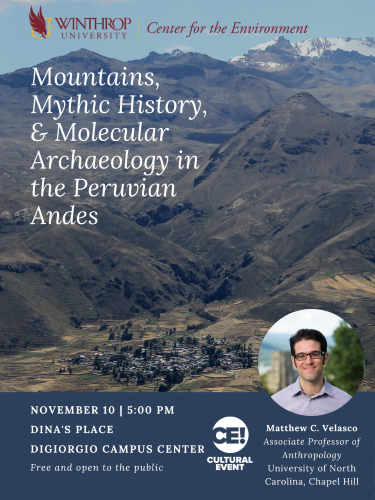
Matthew C. Velasco (Ph.D., Anthropology, Vanderbilt University) is an Associate Professor of Anthropology at the University of North Carolina, Chapel Hill. An anthropological bioarchaeologist, he studies ancient populations of the Peruvian Andes through the analysis of their skeletal remains. He is the author of The Mountain Embodied: Head Shaping and Personhood in the Ancient Andes (University of Texas Press, 2025), which examines the meanings and motivations behind the practice of binding infants’ heads. His research has been supported by the National Science Foundation, the Wenner-Gren Foundation, the Ford Foundation, and the Institute for Citizens and Scholars.