ROCK HILL, SOUTH CAROLINA – Almost half of South Carolinians think there will be a civil war in the U.S. in the next few years, according to the latest Winthrop Poll. Democrats are more likely than Republicans to believe there will be a civil war. (Table 6.1)
Among those who follow the news most of the time or get their news from national cable news, 43% believe a civil war is likely, while nearly 60% do not. Most South Carolinians who consider themselves well-qualified to participate in politics (58%) do not think a civil war is imminent, though 43% do. Fifty-five percent of those who feel better informed about politics and government than most believe a civil war is unlikely, but 45% think otherwise. (Table 6.2)
Poll Director Dr. Scott Huffmon adds, “Democrats appear to be much more worried about the possibility of a civil war. More than twice as many Democrats strongly believe there will be a civil war in the next few years compared to Republicans. When strongly agree and somewhat agree responses are combined, 56% of Democrats believe a civil war is forthcoming, versus 41% of Republicans. Partisanship aside, people who describe themselves as more engaged and informed about politics are also somewhat more likely to believe that a civil war may be in America’s near future. We can’t tell from these results whether this is an echo chamber effect or the result of being more aware of what is really going on behind the scenes.”
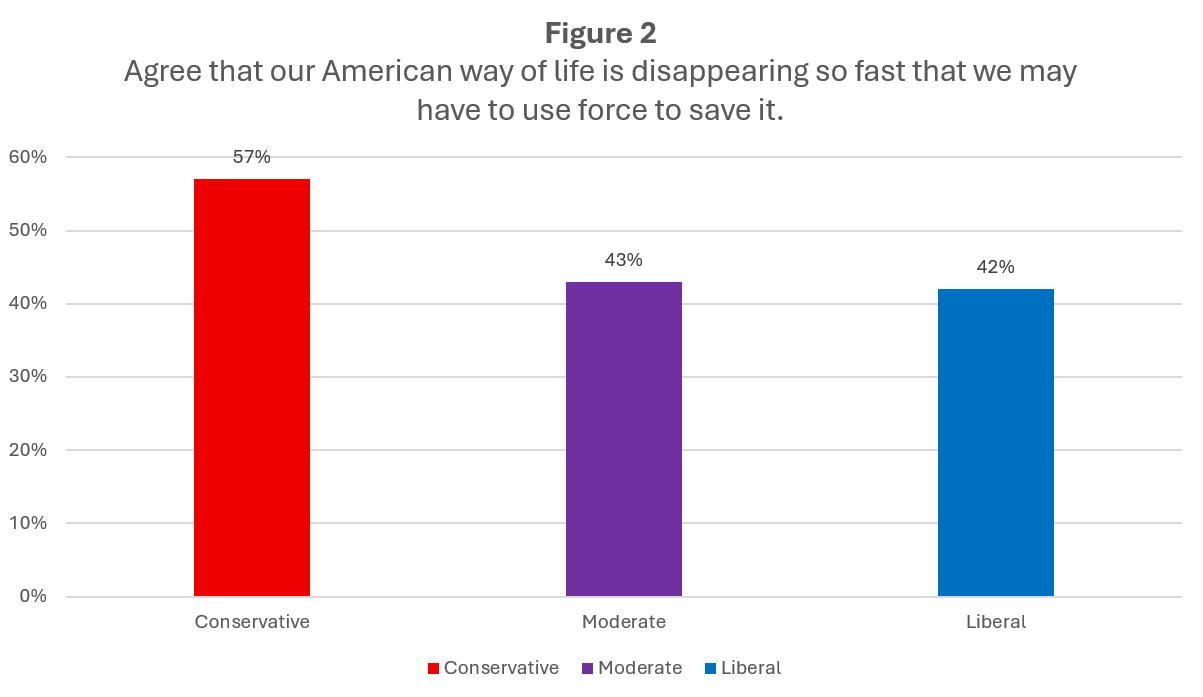
Moderates are more likely than conservatives and liberals to think there will be a civil war soon. Conservatives are the most likely to think there will not be a civil war within the next few years. (Table 6.3)
Nearly 60% of South Carolinians think political violence in the U.S. is currently a very big problem. Another 30% think it is somewhat of a problem, while only 5% think it is not very much of a problem and 1% think it is not a problem at all. (Table 1.1)
Of those who follow the news most of the time, 65% say political violence is a very big problem in the country today, and 29% say it is somewhat of a problem. (Table 1.2)
In general, 73% of South Carolinians believe that using force or violence to advance an important political objective they support is never justified. Twenty-one percent say it is sometimes justified. Republicans, Democrats, and Independents are generally on the same page. (Table 2)
Fifteen percent of South Carolinians say they know someone who they feel might be willing to use force or violence to achieve political objectives. Twenty percent are not sure. (Table 3)
Fifty-nine percent of South Carolinians say it is always unacceptable for a person to be happy about the death of a public figure they oppose, followed by 21% who say it is usually unacceptable. Republicans are more likely than Democrats to think that being happy about the death of a political figure they oppose is unacceptable. (Table 4)
Huffmon explains, “It’s difficult to tell if there is a real difference between Democrats and Republicans regarding celebrating the demise of an opponent as a broadly held viewpoint or if the difference seen in this survey is due to the recency of the murder of Republican commentator and podcaster Charlie Kirk. Nearly 6 in 10 Republicans said they were very or somewhat familiar with Charlie Kirk before his murder and would have naturally been more acutely cognizant of insensitive displays of celebration. It is hard to tell how widespread gratuitous celebrations of Kirk’s death really were, but Republicans would have been more keenly aware of reports of these celebrations, whether the celebrations were truly widespread or the results of the Baader-Meinhof phenomenon. Whether the attitudes would have been reversed after the murder of a prominent Democrat cannot be surmised from this data.”
Before his murder on September 10, 42% of South Carolinians say they were very or somewhat familiar with political activist Charlie Kirk. Twenty percent were not very familiar, 10% had only heard the name, and 28% were not familiar with him at all. Republicans were most likely to be familiar with Kirk prior to his murder. (Table 5)
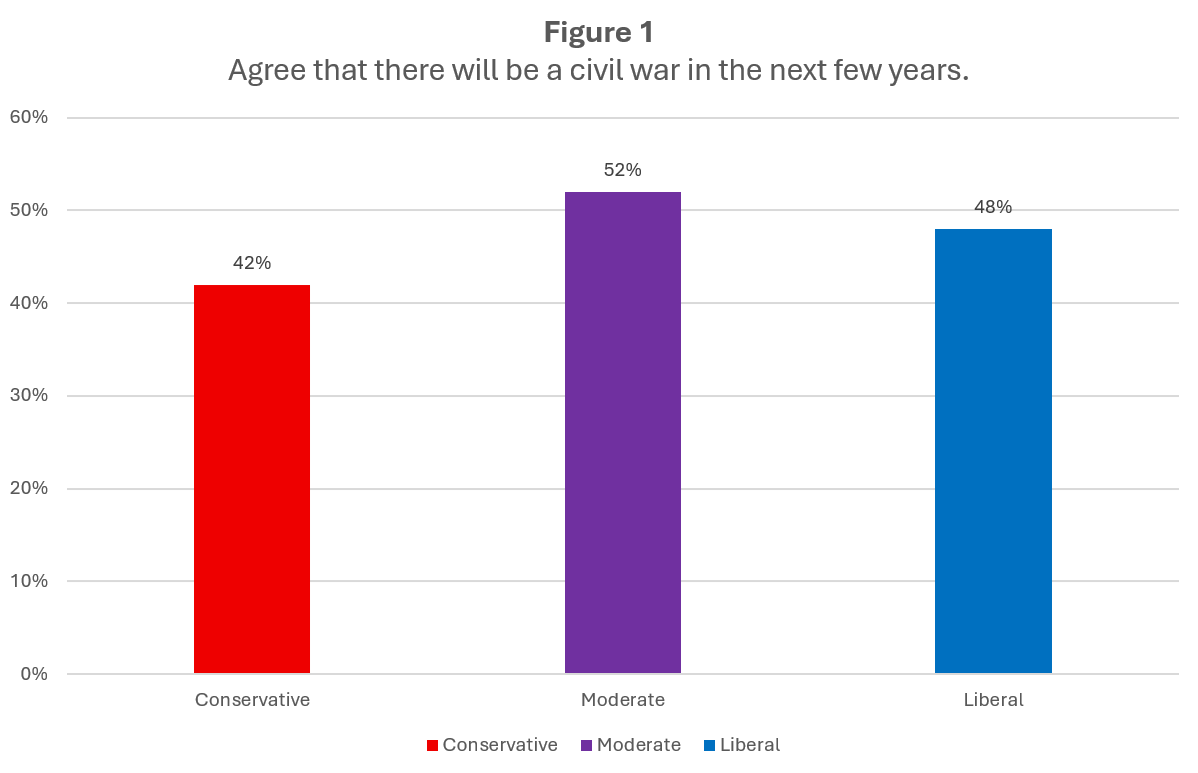
When asked to indicate whether they strongly or somewhat agree or disagree with the statement, “Our American way of life is disappearing so fast that we may have to use force to save it,” nearly half of South Carolinians (48%) say they strongly or somewhat agree. Fifty-two percent strongly or somewhat disagree. Republicans are more likely than Democrats or Independents to agree that force might be necessary to save the American way of life. Similarly, conservatives are more likely than moderates or liberals to agree with the statement. For comparison, a 2022 Ipsos American Life Survey found 43% of Americans to very strongly, strongly, or somewhat agree with the same statement. (Tables 7.1-7.2)
In a PRRI American Values Survey, 23% of Americans agreed with the following statement: “Because things have gotten so far off track, true American patriots may have to resort to violence in order to save our country.” Thirty percent agreed with a similar statement about resorting to violence to get the country back on track in a September 2025 NPR/PBS News/Marist poll. In this Winthrop Poll, 31% of South Carolinians agreed with the statement. Democrats were more likely to agree with the statement than Republicans with 47% of Democrats saying it may be necessary to resort to violence to get the country back on track, compared to 34% of Republicans. (Table 8)
Huffmon stated, “The number of people who think force or violence might be necessary to ‘save our country’ or the ‘American way of life’ is both astounding and disturbing. Sadly, this is not surprising since the numbers we see here are only somewhat above the percentage of people across the country who responded similarly three years ago, according to polls by Ipsos, PRRI, and Marist. Our ongoing polling on polarization might give us some insight. Polarization used to primarily refer to how far apart different sides were on policy issues. Increasingly, polarization is exhibited in beliefs that the other side is fundamentally intolerant, does not respect the country, does not respect democracy, will do anything to win, and can’t be trusted to govern in an ethical and honest way. If a person believes that the other side hates them and the things they love, will oppress them and destroy those things if they get into power, and will cheat to gain power, then that person may come to believe that only force or violence can prevent this from happening. The sad irony is that there are many shared values across the political spectrum, but it is the differences that are highlighted by leaders in order to protect their support within their base.”
Huffmon added, “While we see this fear of the erosion of the American way of life across the political spectrum, there is a clear difference between liberals and conservatives on whether force may be necessary to save it. Nearly 6 in 10 conservatives believe so, as opposed to 4 in 10 liberals. National attitudes regarding the use of ICE to forcibly detain illegal immigrants, whether they have violent records or have been longstanding parts of their community, seem to reflect this conservative-liberal split on what is necessary to save our ‘way of life.’ It also begs the question of what the ‘American way of life’ means to each group.”
See tables and methodology below.
For additional information or to set up an interview with Scott Huffmon, contact Judy Longshaw at longshawj@winthrop.edu or 803/323-2404 (office) or 803/984-0586 (cell).
RESULTS MAY NOT SUM TO 100 DUE TO ROUNDING
How big of a problem do you think political violence is in the U.S. today?
|
|
All Respondents MOE +/-2.23% |
All Republicans (not including leaners) MOE +/-3.65% |
All Democrats (not including leaners) MOE +/-4.36% |
All Independents (not including leaners) MOE 4.36% |
|
A very big problem |
59 |
59 |
58 |
64 |
|
Somewhat of a problem |
30 |
33 |
32 |
26 |
|
Not very much of a problem |
5 |
4 |
6 |
4 |
|
Not a problem |
1 |
1 |
1 |
2 |
|
Not sure |
4 |
3 |
2 |
4 |
How big of a problem do you think political violence is in the U.S. today?
|
|
Respondents who follow the news “most of the time” MOE +/-3.6% |
|
A very big problem |
65 |
|
Somewhat of a problem |
29 |
|
Not very much of a problem |
4 |
|
Not a problem |
2 |
|
Not sure |
1 |
People sometimes talk about using force or violence to achieve political objectives. In general, what do you think about using force or violence to advance an important political objective that you support? Is it…
|
|
All Respondents MOE +/-2.23% |
All Republicans (not including leaners) MOE +/-3.65% |
All Democrats (not including leaners) MOE +/-4.36% |
All Independents (not including leaners) MOE 4.36% |
|
Never justified |
73 |
72 |
75 |
75 |
|
Sometimes justified |
21 |
21 |
18 |
19 |
|
Usually justified |
5 |
5 |
5 |
4 |
|
Always justified |
2 |
2 |
2 |
2 |
Do you know anyone who you feel might be willing to use force or violence to achieve political objectives?
|
|
All Respondents MOE +/-2.23% |
All Republicans (not including leaners) MOE +/-3.65% |
All Democrats (not including leaners) MOE +/-4.36% |
All Independents (not including leaners) MOE 4.36% |
|
Yes |
15 |
15 |
15 |
17 |
|
No |
64 |
64 |
69 |
60 |
|
Not sure |
20 |
20 |
16 |
22 |
|
Prefer not to say |
1 |
1 |
1 |
1 |
Do you generally consider it to be acceptable or unacceptable for a person to be happy about the death of a public figure they oppose?
|
|
All Respondents MOE +/-2.23% |
All Republicans (not including leaners) MOE +/-3.65% |
All Democrats (not including leaners) MOE +/-4.36% |
All Independents (not including leaners) MOE 4.36% |
|
Always acceptable |
5 |
5 |
7 |
4 |
|
Usually acceptable |
6 |
6 |
9 |
6 |
|
Usually unacceptable |
21 |
16 |
22 |
24 |
|
Always unacceptable |
59 |
71 |
51 |
58 |
|
Prefer not to say |
9 |
3 |
11 |
8 |
Before his murder on September 10, how familiar would you say you were with Charlie Kirk?
|
|
All Respondents MOE +/-2.23% |
All Republicans (not including leaners) MOE +/-3.65% |
All Democrats (not including leaners) MOE +/-4.36% |
All Independents (not including leaners) MOE 4.36% |
|
Very familiar |
17 |
30 |
9 |
10 |
|
Somewhat familiar |
25 |
29 |
24 |
27 |
|
Not very familiar |
20 |
18 |
18 |
25 |
|
Had only heard the name |
10 |
7 |
11 |
13 |
|
Not at all familiar |
28 |
17 |
39 |
26 |
In the next few years, there will be a civil war in the United States.
|
|
All Respondents MOE +/-2.23% |
All Republicans (not including leaners) MOE +/-3.65% |
All Democrats (not including leaners) MOE +/-4.36% |
All Independents (not including leaners) MOE 4.36% |
|
Strongly agree |
13 |
8 |
20 |
15 |
|
Somewhat agree |
35 |
33 |
36 |
35 |
|
Somewhat disagree |
30 |
35 |
24 |
31 |
|
Strongly disagree |
22 |
24 |
20 |
20 |
In the next few years, there will be a civil war in the United States.
|
|
Respondents who follow the news “most of the time” MOE +/-3.6% |
Respondents who get news from “national cable news” MOE +/-4.72% |
Respondents who Strongly Agree “I consider myself to be well qualified to participate in politics” MOE +/-5.19% |
Respondents who Strongly Agree “I think that I am better informed about politics and government than most people.” MOE +/-5.13% |
|
Strongly agree |
15 |
10 |
19 |
18 |
|
Somewhat agree |
28 |
33 |
24 |
27 |
|
Somewhat disagree |
32 |
30 |
29 |
28 |
|
Strongly disagree |
26 |
27 |
29 |
27 |
In the next few years, there will be a civil war in the United States.
|
|
Conservative (8-10 on 10-point scale) MOE +/-3.79% |
Moderate (4-7 on 10-point scale) MOE +/-3.08% |
Liberal (1-3 on 10-point scale) MOE +/-6.27% |
|
Strongly agree |
11 |
14 |
13 |
|
Somewhat agree |
31 |
38 |
35 |
|
Somewhat disagree |
33 |
30 |
25 |
|
Strongly disagree |
25 |
19 |
27 |
Our American way of life is disappearing so fast that we may have to use force to save it.
|
|
All Respondents MOE +/-2.23% |
All Republicans (not including leaners) MOE +/-3.65% |
All Democrats (not including leaners) MOE +/-4.36% |
All Independents (not including leaners) MOE 4.36% |
|
Strongly agree |
15 |
15 |
16 |
13 |
|
Somewhat agree |
33 |
38 |
31 |
29 |
|
Somewhat disagree |
25 |
27 |
23 |
27 |
|
Strongly disagree |
27 |
21 |
30 |
31 |
Comparison: 43% of Americans Very Strongly, Strongly, or Somewhat Strongly Agreed with this statement in a 2022 Ipsos American Life Survey.
Our American way of life is disappearing so fast that we may have to use force to save it.
|
|
Conservative (8-10 on 10-point scale) MOE +/-3.79% |
Moderate (4-7 on 10-point scale) MOE +/-3.08% |
Liberal (1-3 on 10-point scale) MOE +/-6.27% |
|
Strongly agree |
18 |
12 |
15 |
|
Somewhat agree |
39 |
31 |
27 |
|
Somewhat disagree |
24 |
27 |
21 |
|
Strongly disagree |
20 |
29 |
37 |
Comparison: 43% of Americans Very Strongly, Strongly, or Somewhat Strongly Agreed with this statement in a 2022 Ipsos American Life Survey.
Because things have gotten so far off track, true American patriots may have to resort to violence in order to save our country.
|
|
All Respondents |
All Republicans (not including leaners) MOE +/-3.65% |
All Democrats (not including leaners) MOE +/-4.36% |
All Independents (not including leaners) MOE 4.36% |
|
Strongly agree |
7 |
6 |
16 |
7 |
|
Somewhat agree |
24 |
28 |
31 |
26 |
|
Somewhat disagree |
28 |
29 |
23 |
23 |
|
Strongly disagree |
41 |
37 |
30 |
44 |
Comparison: 23% of Americans Completely or Mostly Agreed with this same statement in a 2023
PRRI American Values Survey
Comparison: 30% of Americans Agreed with the statement “Americans may have to resort to violence
in order to get the country back on track?” in an NPR/PBS News/Marist Poll conducted
September 2025