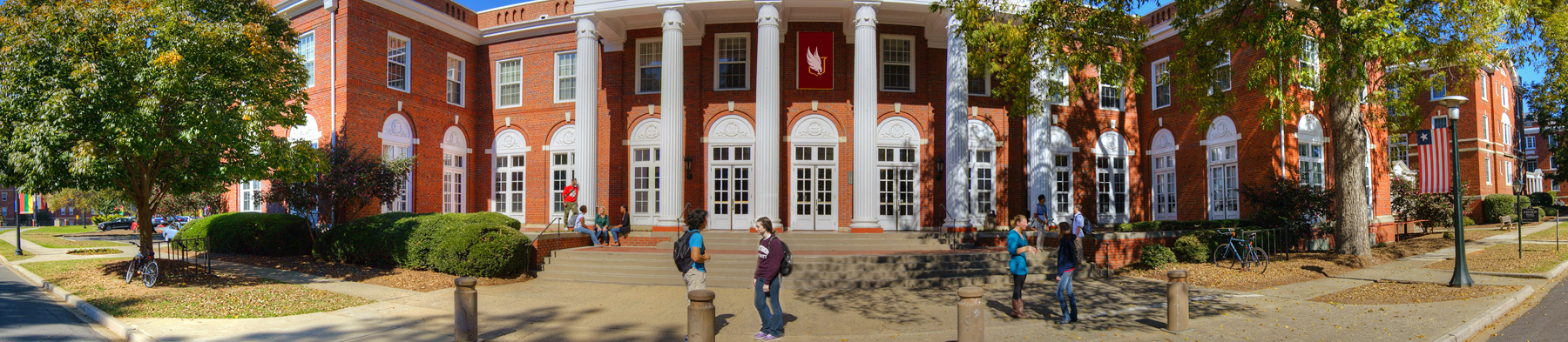
The Center for Public Opinion & Policy Research (CPOPR) is a full-service survey research and data analysis entity at Winthrop University, specializing in telephone and online surveys.
The mission of the CPOPR is threefold: Research, Service, and Teaching.
Founded in 2002 by Dr. Scott H. Huffmon, the CPOPR is the research arm of the Department of Political Science, Philosophy, Religion, & Legal Studies at Winthrop and provides students with real-world, experiential learning opportunities through work with the Winthrop Poll initiative. In the CPOPR, students get to discover the nuances and practical realities of research in ways traditional classroom instruction cannot. The lab also serves as a research platform for university faculty members by providing facilities and expertise for survey-based research projects.
 The CPOPR is a charter member of the American Association for Public Opinion Research’s (AAPOR) Transparency Initiative.
The Winthrop Poll is a long-term survey initiative designed to keep South Carolinians, southeastern residents, and public policy makers across the country in touch with the opinions, attitudes, and dominant viewpoints of South Carolina residents and “The South” as a region. It is the only regular “snapshot” of public policy attitudes of the residents of the South or of the state of South Carolina.
The first Winthrop Poll was conducted in the fall of 2006. From 2007 until 2009, SC ETV and Winthrop partnered to create the Winthrop/ETV Poll initiative. In 2009, these efforts became the Winthrop Poll. The Winthrop Poll alternates between regional, sub-regional, and single state polling with several polls each year.

"The Winthrop Poll offers an invaluable service to the people of South Carolina by providing policy makers with data-driven perspectives on important issues of the day."
- Former Winthrop President Dan Mahoney
The CPOPR assists the Siena College Research Institute (SCRI) with data collection for the New York Times/Siena Poll. Highly-trained CPOPR interviewers conduct telephone interviews for these projects alongside interviewers from SCRI, ReconMR, the Public Opinion Research Lab (PORL) at the University of North Florida, the Institute for Policy and Opinion Research (IPOR) at Roanoke College, and the University of New Hampshire Survey Center.
April 2024 Nationwide Registered Voters Poll
May 2024 Battleground States Poll
July 2024 Nationwide Registered Voters Poll
September 2024 Nationwide Registered Voters Poll
September 2024 North Carolina Registered Voters Poll
October 2024 Texas Registered Voters Poll
October 2024 Arizona Registered Voters Poll
April 2025 Nationwide Registered Voters Poll
The CPOPR does take on external contracts and grants. In addition to providing the public and policy makers accurate information through the Winthrop Poll, the CPOPR seeks to provide top quality and affordable research services to public and private organizations. The CPOPR has extensive experience with program review and evaluation. We offer survey consulting, research instrument construction, data collection, and data analysis, and ensure that clients are provided with unbiased, uncompromising, and unparalleled research to meet their needs.
The CPOPR has a strict policy of never taking as clients candidates for political office, political parties, partisan groups, or entities whose primary purpose is partisan in any way.
If you are interested in learning how the CPOPR can help you, please contact the Director of the CPOPR, Dr. Scott Huffmon, to discuss your project.